Thursday, 19 December 2013

Tuesday, 10 December 2013


Monday, 2 December 2013
Body Copy
‘Anyone can
compose music.’ That is a very bold statement to make from such a young artist,
and if it wasn’t for her amazing talent and critical acclaim, many would
dismiss this claim. It is only after Vera tells us about her musical career so
far and her plans for the future, that I truly understand what she means. After asking her what it was like having her
talent recognised, despite her lack of training, her eyes light up with
enthusiasm. She is unique in that she didn’t have much in the way of formal
training growing up, only really being
taught anything by a professional by September 2010 when she was fast approaching
17.
While there have
been many great male musicians who have emerged from less than affluent
backgrounds, few female composers as young as her and with her magnitude of
skill spring to mind; let alone from poor backgrounds. In her own words she
feels like ‘being recognised is about more than just people recognising me, but
about women in general being given an equal footing in this art, regardless of
their background’. She feels fortunate to have the chance to express that to us.
Her face composes into an expression of relief, obviously eager to get that
answer out as soon as possible.
Assuming this, I
anticipate her answer to my next question ‘Is that what you aim to do then?
Make women more noticed in modern composing?’ in response she looks perplexed
‘It’s what I want to do’, she says, as for why? ‘Yes, there is probably an
aspect of increasing women’s influence in the musical world, but so far my
experience with classical music has been performing and reciting other people’s
music. Like anything, I want to take it to the next level by composing my own piece.
Actually composing will definitely improve my understanding of classical music
further, I love it,
and I don’t just want to make music, I want to create it.’
Now I wear her
formerly perplexed expression as she continues ‘do I want to take my music a
step further in this way because I am a musician, or a woman? I don’t know, A
little bit of both I suppose’. What strikes me most is the duality of her
answer, which leads to a discussion between us about how there is something of
a tightrope walk when you are an influential woman in any form of art.
Ultimately, she smartly puts it ‘I want to show people that women can do this
too, but that’s not all I want to show them’.
Now realising
this internal struggle of wanting to have a message of gender equality, without
letting her gender become her most recognisable label, I ask to what extent she
might reflect this in her music. She responds
‘Composers fight political battles with their music. One of my favourite
composers of all time, Shostakovich, rebelled against the government through
his music’. We become briefly
side-tracked, talking about the great Russian composer. She comments that the
most remarkable thing about him was with what subtly his messages were embedded
in his compositions, to which I can do nothing but agree. Returning to the
question at hand Vera responds saying ‘I can only hope to emulate him once I
get a chance at composing. My message will be a driving force at least in my
first few compositions’. I am now beginning to understand what she meant by ‘Anyone
can compose music.’
Wednesday, 20 November 2013

Friday, 15 November 2013

Thursday, 14 November 2013

Wednesday, 13 November 2013

Tuesday, 12 November 2013


Monday, 11 November 2013
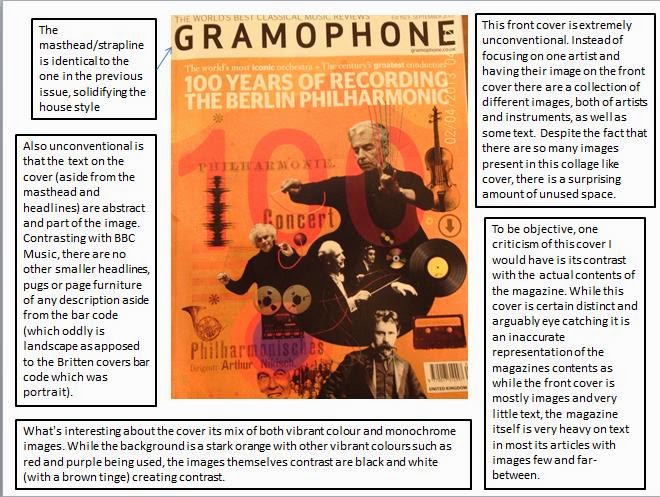
Gramaphone front cover analysis 2
After analysing this front cover (as
well as the previous gramophone front cover I looked at) I realised that due to
its unconventionality, I may not be able to draw much influence from
this cover due to not only its unconventionality, but the complications
involved in replicating its look when I come to create my final product.
However I feel that it is still important to analyse this cover to serve as a
contrast to the more conventional covers I have looked at, such as those of BBC
Music, in order to broaden my understanding of the codes and conventions of
classical magazines overall.


Saturday, 9 November 2013

Friday, 8 November 2013

Thursday, 7 November 2013

Wednesday, 6 November 2013
Initial Font Ideas
When choosing fonts I considered my target audience as well as my ideology (that being intelligent but approachable). Taking this into account, these are some of the initial fonts I found on DaFont.com and am considering using on the front page of my product.





Tuesday, 5 November 2013
Title Ideas
While initially thinking of names for my magazine, many Italian musical terms came to me, but after considering my target audience I thought it would be best to avoid the more obscure terms and stick to ones that most people would be familiar with. These were some of my initial ideas.
Symphony/Rhapsody/Melody- these were three of my first ideas as they are all fairly well known terms that you don't need to be a composer to know, yet are still directly linked to the classical genre. A symphony being an extended composition, a rhapsody being a composition that is divided into various episodes but flows freely, and a melody simply being a linear composition. The more I contemplated the less I liked all three of these titles, as while well-known they do still give of a little too much sophistication, to the point that I think it makes them sound intimidating (especially Symphony and Rhapsody) and on top of that, aside from Melody, they are a little long and I think a short, snappy title would be better. To top it off their meanings don't really hold any significance to my magazines ideology.
Muse- Muse was a name I briefly considered, and while it is snappy and approachable I find it to be a little vague as it could really describe any genre of music magazine. On top of that there are already 4 other magazines with this name.
Vivace- Vivace was a name I liked at first, it is an Italian music phrase meaning fast but lively. However considering I wanted a name that was recognisable and not intimidating I discontinued this line of thought.
Forte- Forte was a name I also liked initially due to the fact that while it is an Italian musical word, it is known by people who aren't particularly into classical music. On top of that its extremely short and easy to remember. My only quam with it as a title is that it didn't exactly translate into my magazines ideology, as all forte means is 'loud'.
Motif-At this point in time the name I like the most is Motif, for a lot of the same reasons I like forte. As it is very short, pithy and easy to remember, on top of that while it is an Italian music term it is used in almost every other art to describe a recurring theme in a piece of art. In classical music however it means a similar thing; a recurring figure in a piece that has an important characteristic and is meant to covey an idea in a condensed or quick way. In a way, this links to the ideology behind my magazine as it is about classical music, but in a more approachable way, it like a motif expresses big things (ideas or music) in a humble way. I would say this is most likely to be my final title.
Symphony/Rhapsody/Melody- these were three of my first ideas as they are all fairly well known terms that you don't need to be a composer to know, yet are still directly linked to the classical genre. A symphony being an extended composition, a rhapsody being a composition that is divided into various episodes but flows freely, and a melody simply being a linear composition. The more I contemplated the less I liked all three of these titles, as while well-known they do still give of a little too much sophistication, to the point that I think it makes them sound intimidating (especially Symphony and Rhapsody) and on top of that, aside from Melody, they are a little long and I think a short, snappy title would be better. To top it off their meanings don't really hold any significance to my magazines ideology.
Muse- Muse was a name I briefly considered, and while it is snappy and approachable I find it to be a little vague as it could really describe any genre of music magazine. On top of that there are already 4 other magazines with this name.
Vivace- Vivace was a name I liked at first, it is an Italian music phrase meaning fast but lively. However considering I wanted a name that was recognisable and not intimidating I discontinued this line of thought.
Forte- Forte was a name I also liked initially due to the fact that while it is an Italian musical word, it is known by people who aren't particularly into classical music. On top of that its extremely short and easy to remember. My only quam with it as a title is that it didn't exactly translate into my magazines ideology, as all forte means is 'loud'.
Motif-At this point in time the name I like the most is Motif, for a lot of the same reasons I like forte. As it is very short, pithy and easy to remember, on top of that while it is an Italian music term it is used in almost every other art to describe a recurring theme in a piece of art. In classical music however it means a similar thing; a recurring figure in a piece that has an important characteristic and is meant to covey an idea in a condensed or quick way. In a way, this links to the ideology behind my magazine as it is about classical music, but in a more approachable way, it like a motif expresses big things (ideas or music) in a humble way. I would say this is most likely to be my final title.
Target Audience
My magazines target audience will be relatively young for a classical magazine. Specifically around mid 20's-30's or possibly even younger extending to late teens. They would enjoy both old and new classical music as my magazine will focus mainly on modern classical music. My target audience might also enjoy other genres of music like indie, rock or pop, therefor my magazine will assume that the reader is fairly familiar with other genres outside of the classical genre, for example; my magazine may make references to more modern bands or other modern things. Typically classical magazines are sophisticated in their design layout and ideology, and while my magazine would be somewhat similar using formal or fairly articulate language, I want to avoid it being intimidating to someone who enjoys classical music but maybe isn't initiated with all complicated classical terms. In a sentence, it will be intelligent, but approachable.
Saturday, 2 November 2013
Wednesday, 30 October 2013
Classical Mindmap
Along with my mood board, I have also created a mind map of things I associate with the classical genre to help me get a feel for what my final product should look like.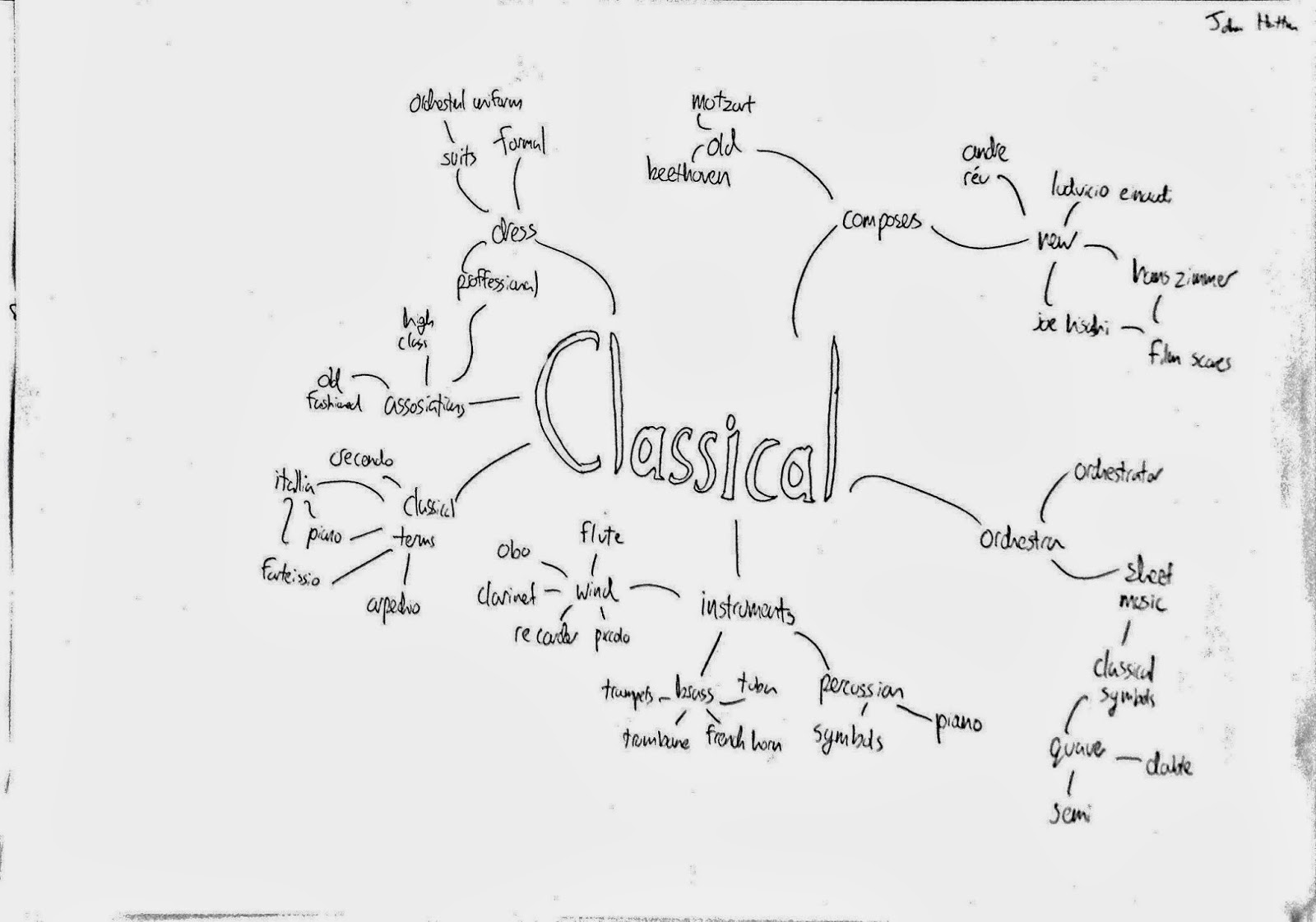
Subscribe to:
Posts (Atom)